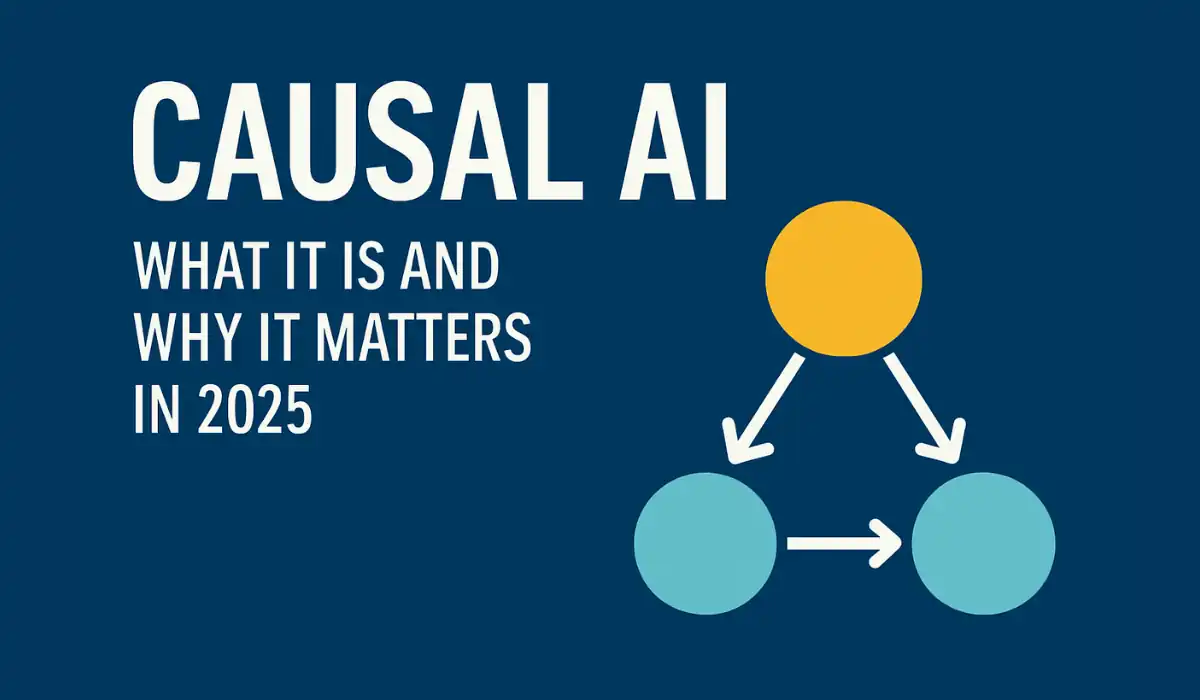
What is Causal AI and why does it matter in 2025?
Causal AI is a new form of artificial intelligence that doesn’t just predict outcomes — it helps us understand why those outcomes happen. In 2025, it’s becoming a game-changer across healthcare, finance, and government because it provides real decision-making support, not just surface-level predictions.
🔍 What Is Causal AI?
Most traditional AI models are great at spotting patterns. They can tell you, for example, that a customer who buys Product A is likely to also buy Product B. But what they can’t tell you is whether one causes the other — or whether something else is driving both.
Causal AI goes beyond prediction. It attempts to understand and model cause-and-effect relationships. This allows for more informed decisions, deeper insights, and improved outcomes across various industries.
Example: A traditional AI might say, “Patients with symptom X are likely to require ICU care.”
Causal AI goes further: “If we administer treatment A within the first 12 hours, we reduce the chance of ICU admission by 40%.”
That difference — understanding why something happens — is what makes Causal AI so powerful.
🔄 Benefits of Causal AI in 2025
It is rising in popularity for several reasons:
- Better Decision-Making Under Uncertainty: It allows simulations of different scenarios and helps choose the best course of action.
- More Transparent and Ethical AI: Since it models reasoning, it’s easier to explain why a decision was made.
- Practical, Actionable Insights: It doesn’t just predict outcomes but offers “what if” scenarios.
- Cross-Industry Flexibility: Its ability to simulate policies, treatments, or campaigns applies to virtually any sector.
🌍 Real-World Applications of Causal AI
• Healthcare
Doctors and hospital systems use causal modeling to compare treatment plans and predict outcomes before committing to patient care strategies. This reduces risk and improves patient results.
• Finance
Banks and investment firms simulate the impact of changes in interest rates or loan policies to make smarter portfolio decisions and reduce economic risk.
• Public Policy
Governments are starting to rely on causal modeling to understand how new policies — such as tax breaks, social programs, or regulations — might affect different populations.
• Marketing & E-Commerce
Companies use causal AI to figure out if a certain ad campaign or product change caused an increase in sales or just happened to coincide with one.
📈 Market Outlook for Causal AI
The market for Causal AI is gaining traction fast. Experts estimate it will grow at a compound annual growth rate (CAGR) of over 40%, reaching more than $56 billion by 2034. As industries demand transparency, accountability, and insight from AI, causal systems will become standard in high-stakes decision-making.
Unlike black-box algorithms, causal systems are more transparent and better aligned with evolving AI regulations in regions like the EU, where explainability is now a legal requirement.
🧠 Final Thoughts
Causal AI is not just another trend. It represents a foundational shift in how we apply artificial intelligence. By moving beyond prediction into the realm of cause and effect, it opens up a new layer of understanding that is actionable, ethical, and more aligned with human thinking.
From predicting patient health outcomes to testing economic policies without real-world consequences, causal AI allows organizations to think ahead with confidence.
For a deeper dive into how it works and its real-world applications, check out this excellent resource by causalens:
👉 Causal AI: The Next Frontier in Artificial Intelligence
Read more: Replit Agent: Build Apps Fast with AI in Your Browser